Being a Go-Giver
14th September 2026 | Rebecca Manning
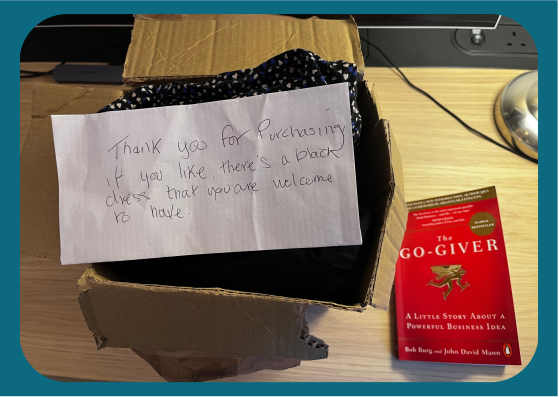
I’m partial to the occasional Vinted purchase, and had such a lovely surprise recently when I opened my delivery to find the seller had added in an extra dress, in case I liked it.
Striding home with the box tucked under my arm, I did think it felt rather heavy for one dress. Thoughts crossed my mind like, “Has she packed the wrong thing?” and, briefly, “Perhaps it’s a severed head.”
But no. No mistake and no murderer-stalker tendencies. Just kindness.
It was such a small thing, but it really made me smile.
It was a reminder of how often we brace ourselves for the worst from people, when actually we’re so often pleasantly surprised. We expect the email to be difficult. We assume someone will say no. We anticipate that a stranger won’t bother, that a colleague won’t have time, or that going the extra mile will simply create more work for us.
And yet, some of the things that make the biggest impression are precisely those small, unexpected gestures: the introduction you weren’t expecting, someone making time to help when they didn’t have to, a thoughtful message received because someone was thinking of you.
Why do we sometimes talk ourselves out of doing these things? Are we worried it will take too long, we will seem too keen, they probably won’t notice, it isn’t our responsibility, that they won’t appreciate it?
It reminded me of The Go-Giver by Bob Burg and John David Mann, and the central idea that value flows from giving more than you take, without expecting something in return.
The Vinted seller didn’t know whether I’d ever buy from her again. She had no guarantee I’d like the dress, or even that I’d particularly appreciate the gesture. There was no obvious transaction attached to it.
She just thought, “I have this dress. Perhaps she might like it. And that was enough.
We often think of generosity as something big: giving a significant amount of money, volunteering for hours, doing someone a huge favour. But generosity can be much smaller and more everyday than that.
Perhaps it’s simply noticing an opportunity to make someone’s experience a little better – and acting upon it.
In business, especially, I think there can be a tendency to focus heavily on efficiency. How quickly can we do this? How little can we spend? What is the minimum we need to deliver? What is actually required?
Valuable questions, but there’s also enormous value in asking: what could I do that isn’t required, but would make this better?
It might be an extra bit of thought, a useful introduction, a handwritten note, sharing something you think someone will genuinely find helpful, or simply doing something kind without attaching an expectation to it.
Not every gesture will be noticed, and we shouldn’t give with the expectation of receiving something back.
Sometimes though, the unexpected extra is exactly what people remember.
So, kind Vinted seller, thank you for the extra dress and for the reminder that small acts of generosity can have a surprisingly long tail.
And as if I needed proof that others feel the same, when I shared this story on LinkedIn, I received the most likes and comments I’ve ever received. I really should write about kindness / free dresses / severed heads more often.